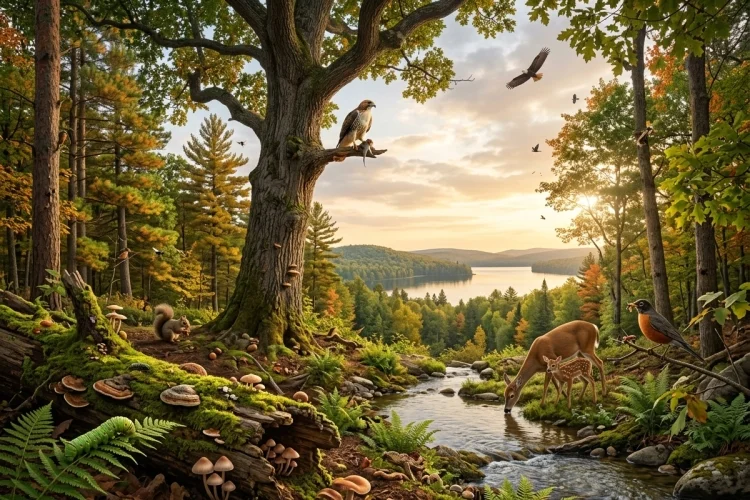
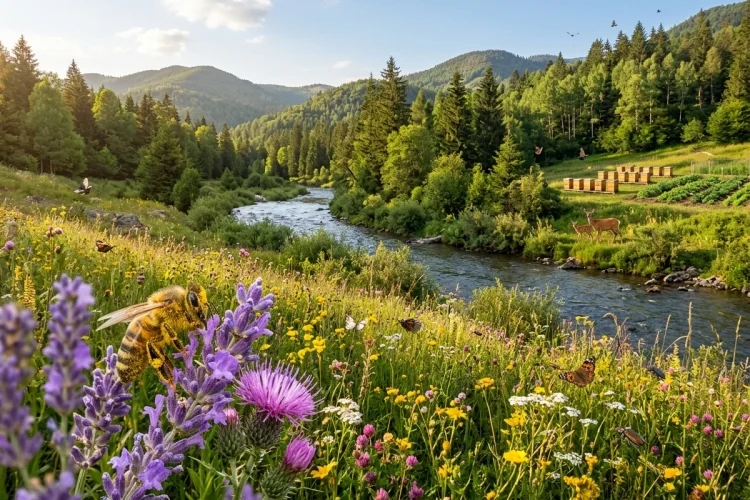
A bee visiting a flower may look like a small everyday event. However, that single interaction connects pollination, plant reproduction, food production, insect behavior, weather, and the survival of many other species.
Ecology is the branch of biology that studies connections like these. It explores how living organisms interact with one another and with nonliving parts of their surroundings, including water, soil, sunlight, temperature, and air.
So, what is ecology and why is it important? Ecology helps us understand how nature works as an interconnected system.
It explains why animal populations rise and fall, how energy moves through food webs, what happens when a species disappears, and how human activities can change entire environments.
Ecological knowledge is also practical. It supports agriculture, wildlife conservation, public health, water management, fisheries, and the restoration of damaged habitats.
By understanding relationships in nature, people can make better decisions about the resources and ecosystems on which daily life depends.
What Is Ecology?
Ecology is the scientific study of interactions between living organisms and their environment. The word comes from the Greek oikos, meaning house or place to live, and logos, meaning study.
Ecologists ask questions such as: Why does a species live in one location but not another? How does competition affect a population? What happens to a forest when rainfall decreases? How does removing a predator influence other organisms?
The environment includes both biotic and abiotic components. Biotic factors are living parts of an ecosystem, such as animals, plants, fungi, and microorganisms.
Abiotic factors are nonliving conditions, including temperature, light, water, minerals, wind, and soil chemistry.
Ecology is therefore much broader than simply studying animals or protecting forests. It examines the relationships that determine where organisms live, how they obtain resources, and how ecosystems respond to natural and human-driven change.
The Main Levels of Ecological Study
Nature can be studied at several connected levels. Ecologists may focus on an individual organism, an entire species population, a community, an ecosystem, or the global biosphere.
1. Organism and Population Ecology
Organismal ecology examines how one organism responds to its surroundings. A researcher might study how a desert lizard regulates body temperature or how a plant survives in salty soil.
Population ecology focuses on members of the same species living in a particular area. It examines population size, distribution, birth rates, death rates, migration, and changes over time.
For example, scientists studying an endangered butterfly might count how many remain, identify the plants its caterpillars need, and investigate why its reproduction is declining. This information can guide habitat protection and conservation programs.
2. Community and Ecosystem Ecology
A community includes all the populations of different species living in the same area. Community ecologists study relationships such as competition, predation, parasitism, and cooperation.
An ecosystem includes the community plus its nonliving environment. A pond ecosystem, for instance, contains fish, insects, algae, bacteria, water, dissolved oxygen, sunlight, and nutrients.
The biosphere is the highest level. It includes all ecosystems and all regions of Earth where life exists. These levels overlap because changes affecting one organism can eventually influence populations, communities, and larger ecological systems.
How Energy and Nutrients Move Through Ecosystems
Every ecosystem needs a source of energy. In most environments, that energy begins with sunlight.
Plants, algae, and certain bacteria capture light through photosynthesis. These organisms are called producers because they create energy-rich organic materials that other organisms can consume.
Herbivores obtain energy by eating producers, while carnivores eat other animals. Omnivores consume both plants and animals. Decomposers, including many bacteria and fungi, break down dead organisms and waste.
Food Chains and Food Webs
A food chain shows a simple path through which energy and nutrients move. Grass may be eaten by a grasshopper, which is eaten by a frog, which may then be eaten by a snake.
Real ecosystems are much more complicated. Most organisms consume more than one type of food and may be eaten by several predators. Connected food chains therefore form a food web.
Food webs help ecologists predict how changes in one population may affect others. Removing a top predator, introducing a new species, or adding excessive nutrients can produce effects that spread through the ecological community.
Energy flows through an ecosystem, but nutrients are recycled. Elements such as carbon, nitrogen, and phosphorus move between organisms, soil, water, and the atmosphere.
How Species Interact With One Another
Organisms constantly interact while searching for food, shelter, space, and mates. These relationships help shape the structure of ecological communities.
Competition happens when organisms need the same limited resource. Trees may compete for sunlight, while animals may compete for nesting areas or food.
Predation occurs when one organism captures and eats another. Although predation harms individual prey, predators can help regulate populations and prevent one species from becoming overwhelmingly dominant.
In mutualism, both participants benefit. Bees receive nectar from flowers while carrying pollen between plants. In parasitism, one organism benefits while harming its host.
Some organisms are described as keystone species because their presence has an unusually large influence on the surrounding community. Removing one can alter food webs, population sizes, and biodiversity far beyond what might be expected from its abundance.
These relationships are not always fixed. Their effects can change with food availability, climate, population density, or other environmental conditions.
Why Ecology Is Important to Human Life
Humans are part of ecosystems rather than separate from them. Food, clean water, breathable air, medicines, raw materials, and many economic activities depend on functioning natural systems.
The benefits people receive from nature are often called ecosystem services. These include pollination, water purification, fertile soil, flood control, carbon storage, coastal protection, and the production of food and materials.
Wetlands, for example, can store water and reduce the effects of flooding. Forest vegetation helps protect soil from erosion, while insects and other animals pollinate many wild plants and agricultural crops.
Ecosystems also provide recreational and cultural benefits. Beaches, forests, lakes, and coral reefs support tourism, outdoor activities, education, and cultural traditions.
When habitats are damaged, their services may weaken. The cost is not limited to wildlife; communities may also experience poorer water quality, reduced crop productivity, greater erosion, or increased vulnerability to natural hazards.
How Ecology Helps Solve Real-World Problems
Ecological research gives governments, communities, and businesses information for managing natural resources more responsibly.
In conservation, ecologists identify habitat requirements, monitor endangered populations, and study the effects of invasive species. They can also evaluate whether habitat restoration projects are actually rebuilding ecological functions.
Fisheries managers use food-web information, population data, and environmental conditions to estimate how many fish can be harvested without seriously damaging future populations.
Marine ecologists must consider predators, prey, habitat, temperature, and human activity rather than studying one fish species in isolation.
Ecology is also important in agriculture. Knowledge of pollinators, soil organisms, pests, predators, and nutrient cycles can help farmers improve production while reducing environmental damage.
Urban ecology examines wildlife, vegetation, water, heat, pollution, and human communities within towns and cities. This research can guide the development of parks, green roofs, drainage systems, and wildlife corridors.
As climate conditions change, ecology helps researchers predict which species may move, decline, or face new competition. These predictions can support practical decisions about conservation, water supplies, agriculture, and coastal management.
How Ecologists Study Nature
Ecologists combine field observations, experiments, technology, and mathematical models. The method depends on the organism, ecosystem, and research question.
A population researcher may count plants inside square sampling areas called quadrats. Wildlife scientists may use cameras, tracking devices, sound recordings, or genetic samples to detect animals that are difficult to observe directly.
Experiments allow researchers to test cause and effect. They might adjust light, water, nutrients, or predator access in controlled areas and compare the results.
Large ecosystems are difficult to manipulate directly, so scientists also create computer models. These models combine information about populations, climate, food webs, and environmental conditions to explore possible future changes.
Ecology often requires long-term observation. A forest or animal population may appear stable during one season but reveal major trends when studied across many years.
Ecology Is Not the Same as Environmentalism
Ecology and environmentalism are connected, but they are not identical. Ecology is a scientific discipline that gathers and tests evidence about natural systems.
Environmentalism is a social and political movement concerned with protecting the environment. It may use ecological research when supporting policies or public action.
An ecologist can study pollution without campaigning for a particular law. Similarly, an environmental organization may use findings from ecology, economics, public health, and other fields.
Understanding the difference is useful because ecological science does not simply tell society what values to choose. Instead, it helps explain the likely consequences of different decisions.
Ecology is the study of how organisms interact with one another and with their physical environment. It examines life at several levels, from individual organisms and populations to communities, ecosystems, and the biosphere.
The field explains food webs, population changes, species relationships, nutrient cycles, and the effects of environmental disturbance.
It also shows why healthy ecosystems matter to people by supporting food production, clean water, pollination, flood control, recreation, and many other benefits. Start exploring ecology by observing a nearby garden, park, beach, or pond.
Identify its living and nonliving components, then look for feeding relationships, competition, and cooperation. Even a small habitat can reveal how deeply connected the natural world really is.