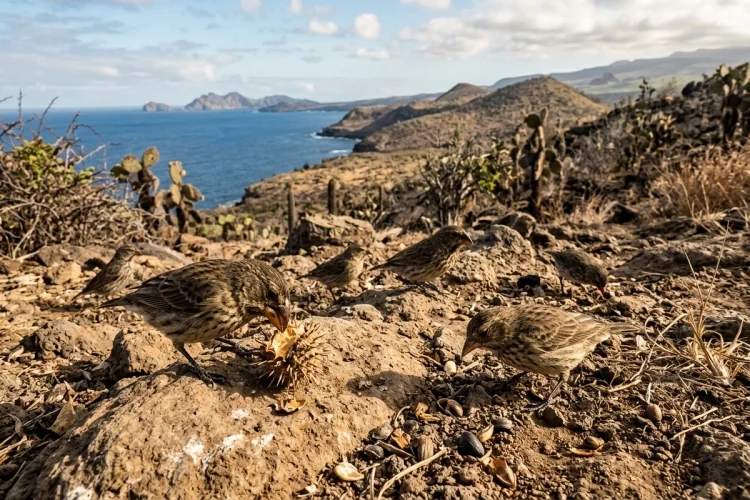
Picture a group of small birds living on an island. Some have thin beaks that are useful for eating soft seeds, while others have thicker beaks that can crack harder food.
When a long drought leaves mostly tough seeds behind, birds with stronger beaks may have a better chance of finding enough food.
If beak size is inherited, those surviving birds may pass the helpful characteristic to their offspring. After several generations, thick beaks could become more common in the population. That, in simple terms, is natural selection.
Natural selection is one of the main mechanisms of evolution. It happens when individuals with certain inherited traits survive or reproduce more successfully than others in the same environment. As those traits are passed on, the population gradually changes.
The process is not planned, and organisms do not develop new features simply because they need them. This guide offers natural selection explained in simple terms, including how it works, what “fitness” really means, and where we can observe it in action.
What Is Natural Selection?
Natural selection is the process through which inherited characteristics that improve reproductive success become more common in a population over generations.
Individuals within a species are not completely identical. They may differ in color, size, disease resistance, behavior, metabolism, or many other features.
When some of these differences affect survival and reproduction, the environment effectively “selects” which traits are more likely to continue.
The environment does not consciously choose winners. Temperature, predators, diseases, food supplies, mates, and competition simply create conditions in which certain individuals perform better than others.
Natural selection acts on individual organisms, but its evolutionary effects appear in populations. One animal does not evolve during its lifetime. Instead, the frequency of inherited traits changes across multiple generations.
The Four Ingredients Natural Selection Needs
Natural selection depends on several conditions working together. First, a population must contain variation. A group of insects might include individuals with different colors, for example.
Some of that variation must also be heritable. A scar caused by an accident cannot normally be passed to offspring, but a genetically influenced body color may be inherited.
The environment must then create differences in survival or reproduction. If birds can easily see green insects on dark tree bark, darker insects may be eaten less often.
Finally, individuals with helpful inherited characteristics must leave more offspring. Over time, the alleles connected to those traits may become more common in the gene pool.
New genetic variation ultimately comes from mutations, while sexual reproduction creates fresh combinations of existing variants.
Natural selection does not invent useful traits from nothing; it works with variation already present in the population or introduced through genetic change.
How Natural Selection Works Step by Step
Imagine a population of rabbits living in a cold region. Some naturally have slightly thicker fur than others because of inherited genetic differences.
A particularly cold series of winters makes survival difficult. Rabbits with thicker fur may be more likely to stay warm, find food, and live long enough to reproduce.
Their offspring may inherit genes associated with thicker fur. If the cold conditions continue, these rabbits may also enjoy a reproductive advantage.
After many generations, the average rabbit in the population may have thicker fur than its ancestors. The population has adapted to local conditions through natural selection.
This example is simplified. Real traits are often influenced by multiple genes, and organisms face several environmental pressures at once.
A thicker coat might improve cold tolerance but require more energy to grow or become uncomfortable during warmer periods.
Natural selection therefore produces trade-offs rather than perfect organisms. It can only modify available biological features, and a trait that is helpful today may become less useful when conditions change.
What Does “Survival of the Fittest” Really Mean?
The phrase “survival of the fittest” often creates the wrong picture. It may sound as though evolution always favors the strongest, fastest, or most aggressive individual.
In biology, fitness refers mainly to reproductive success. A fit organism is one whose inherited traits help it contribute more offspring to future generations than other members of its population.
Strength may increase fitness in some situations, but other characteristics can matter more. Better camouflage, resistance to a disease, efficient digestion, or the ability to attract a mate may all improve reproductive success.
Fitness is also relative to a particular environment. A white coat may help an animal avoid predators in snow but make it easier to spot on dark ground.
This is why there is no universally “best” trait. Natural selection favors characteristics that work well under current local conditions. When those conditions change, the direction of selection may change too.
Real Examples of Natural Selection
1. Galápagos Finch Beaks
A famous example comes from medium ground finches studied by Peter and Rosemary Grant on Daphne Major in the Galápagos Islands.
During a severe drought in 1977, small and soft seeds became scarce. Many surviving seeds were larger and harder, giving birds with deeper, stronger beaks an advantage.
More than 80 percent of the finches died during that period. The birds that survived tended to have larger beaks, and their offspring inherited a larger average beak size.
Researchers had observed measurable evolutionary change within only a few generations. This did not mean that individual birds intentionally enlarged their beaks.
Variation in beak size already existed before the drought. The change in food supply simply favored birds whose inherited features were more useful under the new conditions.
2. Antibiotic Resistance
Antibiotic resistance is another practical example. A bacterial population may contain a few cells with mutations or acquired genes that help them survive a particular antibiotic.
When the medicine is used, susceptible bacteria die while resistant ones are more likely to remain and reproduce. The antibiotic does not teach bacteria how to resist it. Instead, it creates selection pressure that favors variants already capable of surviving.
Over time, resistant bacteria can become a larger part of the population. This is one reason antibiotics should be used only when appropriate and exactly as directed by healthcare professionals.
Different Patterns of Natural Selection
Natural selection does not always push a population in the same direction. Scientists recognize several patterns based on which traits receive an advantage.
Directional selection favors one end of a trait range. If larger beaks consistently improve survival, the population’s average beak size may gradually increase.
Stabilizing selection favors intermediate characteristics. Very small and very large newborn sizes, for example, may carry greater risks than sizes closer to the population average.
Disruptive selection favors both extremes over the middle. Birds with either very small or very large beaks might succeed if only tiny and large seeds are available, while medium-sized beaks perform poorly with both foods.
Sexual selection is related to differences in mating success. Bright feathers, songs, displays, or competitive structures may spread when they help individuals attract mates, even when those features create survival costs.
These patterns can change the average trait, reduce variation, or divide a population into more distinct groups.
Common Misunderstandings About Natural Selection
One common mistake is saying that organisms evolve because they try to adapt. A giraffe does not stretch its neck and then pass a longer acquired neck to its offspring.
Natural selection works on inherited variation. Individuals with useful variants may reproduce more successfully, making those variants more frequent in later generations.
Another misconception is that evolution always represents progress. Natural selection does not move life toward a predetermined goal or automatically create greater complexity.
It also does not guarantee survival. A well-adapted population can still disappear if its environment changes too rapidly or if a disaster destroys too many individuals.
Finally, natural selection is not the same as evolution itself. Evolution can also occur through mutation, gene flow, and genetic drift. Natural selection is distinctive because it produces adaptations that can make populations better suited to particular environments.
Why Natural Selection Matters Today
Natural selection helps scientists understand more than fossils and ancient species. It influences medicine, public health, farming, conservation, and wildlife management.
Researchers use evolutionary principles to study how viruses and bacteria change, how pests develop resistance to pesticides, and how cancer cells respond to treatment.
Conservation biologists examine genetic variation when assessing whether a small population can adapt to environmental change. Agricultural researchers also consider selection when breeding plants and animals or managing resistant weeds and insects.
Understanding the process also changes how we view nature. Features such as bird beaks, animal camouflage, plant defenses, and disease resistance are not random decorations. They reflect long histories of variation, inheritance, environmental pressure, and reproduction.
Natural selection occurs when individuals with helpful inherited traits leave more offspring than others in the same population. Across generations, those traits can become increasingly common, allowing the population to adapt to its environment.
The process requires variation, inheritance, selection pressure, and differences in reproductive success. It has no plan, does not create perfect organisms, and does not cause individuals to evolve during their lifetimes.
Examples such as changing finch beaks and antibiotic-resistant bacteria show that natural selection is not limited to the distant past. It continues wherever organisms reproduce and face environmental challenges.
Look at an organism near you and consider which traits might help it survive and reproduce. Asking that simple question is a great way to begin seeing evolution in action.