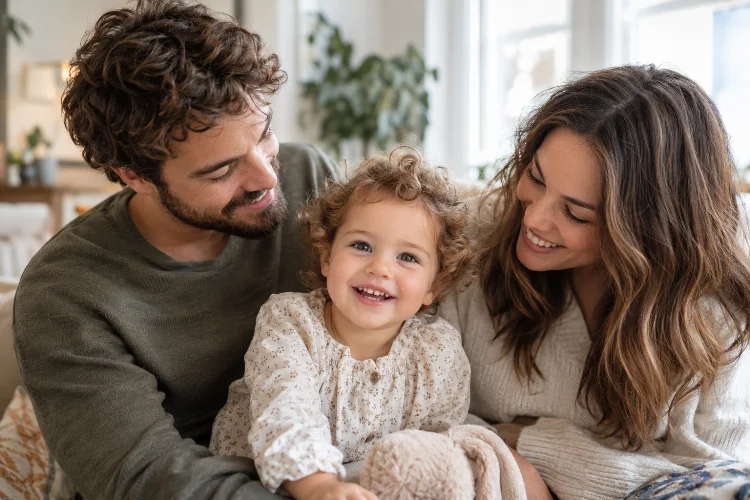
Have you ever wondered why a child might have their mother’s eyes, their father’s hair texture, or a height somewhere between both parents?
Family resemblance can sometimes feel almost magical, but behind it is a biological process that scientists have been studying for generations.
Understanding how traits are passed from parents to children starts with genetics. Parents pass DNA to their children through reproductive cells, and that DNA contains thousands of genes that influence how the body develops and functions.
But inheritance is not as simple as copying one parent’s characteristics onto a child. Every child receives a unique combination of genetic material.
Genes can interact with one another, some variants can be dominant or recessive, and many characteristics are influenced by dozens-or even thousands-of genetic variations.
The enviroment matters too. Nutrition, lifestyle, health, and other factors can influence how inherited genetic potential is expressed.
So how does the whole process actually work? Let’s start with the genetic information parents pass along.
Genes Are the Basic Units of Heredity
A gene is a segment of DNA with a biological function. Some genes provide instructions for producing proteins, while others help regulate how genetic information is used.
Genes are one of the main ways biological information moves from one generation to another. Most people carry two copies of many genes, with one copy inherited from each biological parent.
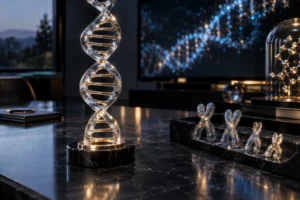
DNA itself is the hereditary material that stores these instructions. Human DNA contains roughly three billion chemical bases, arranged in sequences that cells can read and use.
You can think of DNA as a massive instruction library and genes as specific sections containing particular instructions.
However, people do not necessarily inherit identical versions of every gene.
Different versions or DNA sequences at the same genomic location are called alleles. A person can inherit one allele from their mother and another from their father.
These differences help create biological variation between people.
Chromosomes Carry Genetic Information from Both Parents
Genes are organized along structures called chromosomes.
Most human body cells contain 46 chromosomes, arranged in 23 pairs. For each pair, one chromosome comes from the biological mother and the other comes from the biological father.
That means children receive approximately half of their nuclear chromosomes from each parent.
The process starts with reproductive cells.
Egg cells normally contain 23 chromosomes, and sperm cells also contain 23. When an egg and sperm combine during fertilization, the resulting cell usually has the full set of 46 chromosomes.
Those chromosomes contain thousands of genes inherited from both sides of the family.
Why Siblings Are Genetically Different
If siblings have the same parents, why don’t they look exactly alike?
One major reason is that the chromosomes placed into each egg or sperm are not always the same combination.
During the formation of reproductive cells through meiosis, chromosome pairs are distributed into new cells. DNA can also be exchanged between paired chromosomes through a process known as recombination or crossing over.
As a result, every egg and sperm contains a slightly diferent genetic combination.
Fertilization adds another layer of randomness because any one sperm may combine with any one egg. This creates an enormous number of possible genetic combinations, which is why brothers and sisters can share many features while still looking noticeably different.
Dominant and Recessive Alleles Explain Some Traits
One of the most familiar ideas in genetics is the difference between dominant and recessive inheritance.
In a simple Mendelian pattern, a dominant allele can influence a characteristic when just one copy is present. A recessive allele generally needs two copies to produce the associated phenotype.
Imagine a fictional gene with two alleles, A and a.
Someone with AA or Aa might show the characteristic associated with dominant allele A, while someone with aa might show the recessive characteristic.
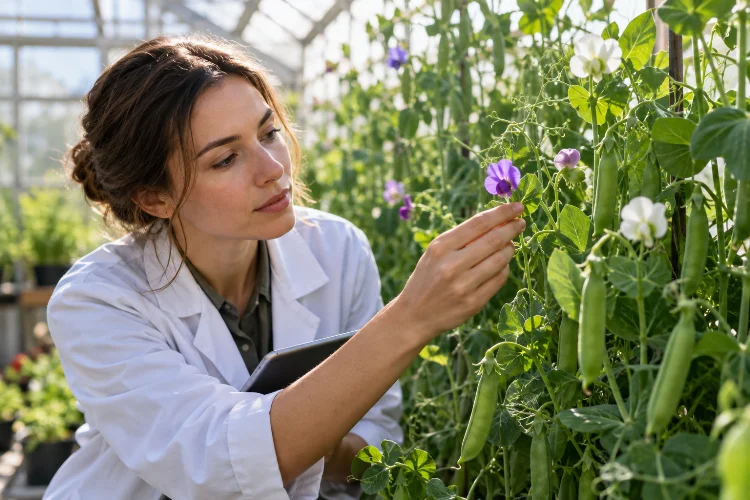
These basic patterns were first described through Gregor Mendel’s famous experiments with pea plants. His research established important principles for understanding heredity.
However, there is an important catch: most human traits are not controlled by such a simple dominant-versus-recessive system.
The Mendelian model is useful for learning basic genetics, but real human biology is often far more complicated.
Many Human Traits Are Controlled by Multiple Genes
Characteristics such as height, skin pigmentation, hair characteristics, and eye color usually involve interactions among multiple genes.
These are often called polygenic traits.
Eye color is a good example. It was once commonly taught as if a single brown-eye gene simply dominated a blue-eye gene. Modern genetics has shown that eye color involves multiple genes, including important regions involving OCA2 and HERC2, along with several others.
That is why predicting a child’s eye color based only on the parents’ eye colors can sometimes produce unexpected results.
Height is even more complex.
Hundreds of genetic variants are associated with differences in height, and environmental influences such as nutrition and childhood health also contribute. MedlinePlus notes that inherited DNA variation accounts for a large portion of height differences, but it does not act alone.
So a child may grow to a similar height as their parents while still ending up noticeably taller or shorter.
Inheritance is less like copying a single recipe and more like combining thousands of biological instructions.
Genotype and Phenotype Are Not the Same Thing
Two useful words for understanding inheritance are genotype and phenotype.
A genotype refers to an individual’s genetic makeup or particular genetic variants. A phenotype is the observable characteristic produced through the interaction of genetic information with biological and environmental factors.
For example, someone may inherit genetic variants associated with greater potential height. But reaching that potential can depend partly on adequate nutrition, overall health, hormones, and childhood living conditions.
This distinction matters because genes are not always destiny.
Researchers use the term heritability to describe how much variation in a trait within a population is associated with genetic differences. It does not mean that a certain percentage of one person’s characteristic is “caused by genes.”
If a trait has a heritability estimate of 70%, for example, that does not mean that one individual’s trait is 70% genetic and 30% environmental.
Instead, it describes variation among people in a particular population under particular conditions.
Environment Can Influence Inherited Traits
DNA provides biological instructions, but those instructions operate inside a real-world enviroment.
Food availability, physical activity, exposure to sunlight, illness, stress, hormones, and many other influences can affect observable characteristics.
Height provides an easy example again. A child may inherit many variants associated with taller stature but may not reach the same height they would have reached under different nutritional or health conditions.
Genetics and environment therefore often work together instead of competing against each other.
This interaction also explains why people who share a lot of DNA can still develop differently.
Even identical twins, who begin with nearly identical genomes, can eventually differ in some physical and health characteristics because their experiences and biological conditions are not perfectly identical throughout life.
Understanding inheritence means looking at both the genetic blueprint and the conditions in which that blueprint operates.
Not Every Inherited Trait Follows the Same Pattern
Mendelian dominant and recessive inheritance receives plenty of attention in introductory biology, but several other inheritance patterns exist.
In codominance, two different alleles can both contribute visibly to a characteristic. The ABO blood group system provides a familiar example: the A and B alleles can both be expressed, producing blood type AB.
Some genetic conditions are X-linked, meaning the relevant gene is located on the X chromosome. Others involve mitochondrial DNA, which follows a different inheritance pattern from nuclear chromosomes.
There are also conditions influenced by many genes together with environmental factors.
This is why a family tree does not always reveal an obvious inheritance pattern.
Even when a trait appears repeatedly across generations, scientists may need genetic testing and detailed family information to understand exactly what is happening.
Why Children Can Resemble Grandparents or Other Relatives
Sometimes people notice that a child looks surprisingly similar to a grandparent, aunt, uncle, or another relative rather than strongly resembling either parent.
There is nothing unusual about this.
Parents carry DNA they inherited from previous generations. They may pass certain combinations of those genetic variants to their children even when those characteristics are not especially obvious in themselves.
A parent can also carry a recessive allele without displaying the associated characteristic. If the other parent carries a compatible allele, the characteristic may appear in their child.
Recombination also creates new combinations of DNA from earlier generations.
So traits do not literally “skip” generations in some mysterious way. Instead, genetic variants can remain present in a family and appear differently depending on which combinations are inherited.
The occurence of a particular feature in a child is therefore part of a much larger family genetic history.
Why Understanding Genetic Inheritance Matters
Knowing how traits move between generations is useful for much more than explaining eye color or family resemblance.
Genetics plays a major role in medicine.
Some inherited variants increase the likelihood of particular genetic conditions, while others can influence how individuals respond to medications or certain environmental factors.
Inheritance patterns can also help families understand the probability of passing particular genetic disorders to children.
For example, some autosomal dominant conditions can involve a 50% chance of transmitting a disease-associated variant from an affected parent to each child, while recessive disorders follow a different probability pattern.
These probabilities apply independently to each pregnancy-they do not guarantee what will happen to any particular child.
This is one reason genetic counselors can be valuable for families dealing with known inherited disorders. They can help interpret family history, genetic test results, and inheritance risks.
Understanding how traits are passed from parents to children begins with DNA. Parents pass chromosomes containing thousands of genes to their children, and different versions of those genes-called alleles-help create variation between individuals.
Some characteristics follow relatively simple dominant or recessive patterns, but many human traits are much more complex. Multiple genes, recombination, random chromosome inheritance, and environmental influences all contribute to what we eventually observe.
That is why children can resemble both parents without becoming exact copies of either one-and why siblings from the same family can look surprisingly different.
Instead of thinking of heredity as copying traits, think of it as reshuffling an enormous biological library every generation. Keep exploring genes, chromosomes, DNA, and inheritance, and the patterns behind family resemblance become much easier to understand.