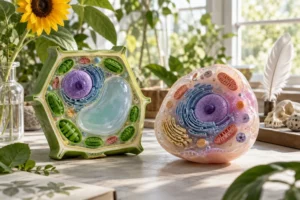
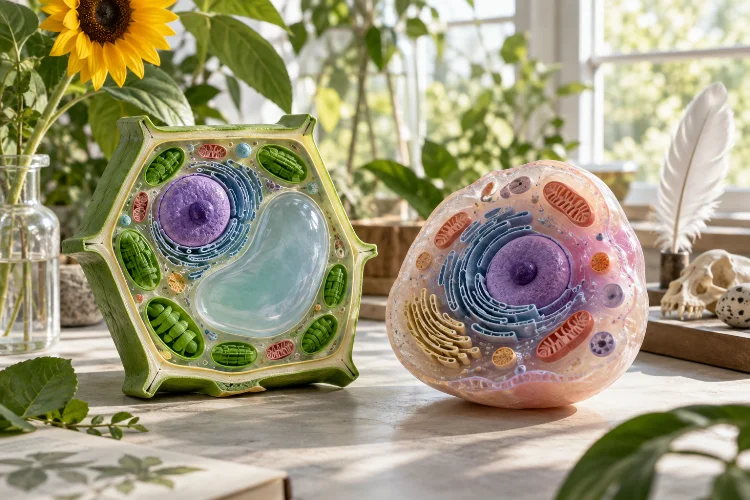
If you looked at a cat and a sunflower, you probably would not think they have much in common. One moves, eats, and reacts quickly to its surroundings, while the other stays rooted in the ground and uses sunlight to produce food.
Yet when we zoom down to the microscopic level, both are built from cells that share many of the same basic components.
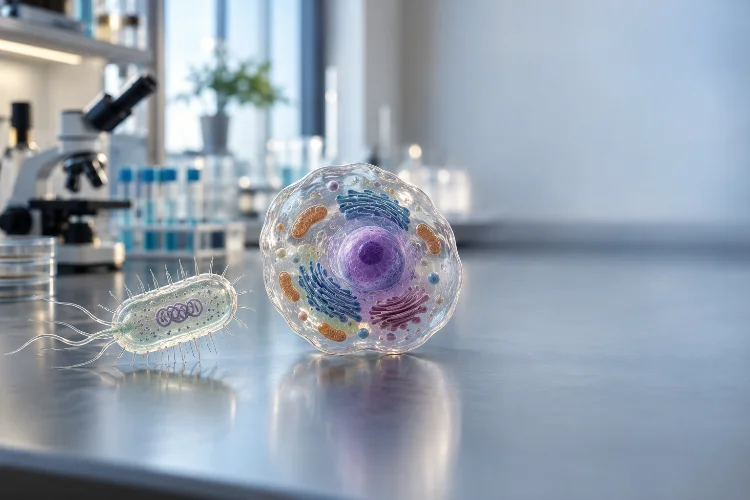
That is where the animal cells vs. plant cells comparison gets interesting. Both animal and plant cells are eukaryotic, meaning they contain a nucleus and other membrane-bound organelles.
They both use DNA, produce energy through mitochondria, and depend on complex internal machinery to stay alive. However, their different lifestyles have also led to several important structural differences.
Plant cells have features designed for support and photosynthesis, while animal cells tend to be more flexible and specialized for movement and interaction.
Understanding these differences makes topics like photosynthesis, cellular respiration, tissue structure, and even food production much easier to understand.
What Are Animal and Plant Cells?
Animal cells are the basic building blocks of animals, from tiny insects to enormous whales. Human skin cells, neurons, muscle cells, and blood-related cells are all examples of specialized animal cells.
Plant cells form the tissues of organisms such as trees, grasses, flowers, vegetables, and mosses. Like animal cells, they contain a nucleus that stores genetic information along with organelles such as mitochondria, ribosomes, the endoplasmic reticulum, and Golgi apparatus.
Because both belong to the eukaryotic category, their overall cellular organization is far more similar than it may initially appear.
The major differences come from their functions. Plants generally remain fixed in one location and must manufacture sugars using light energy. Animals obtain nutrients by consuming other organisms and often require cells capable of greater flexibility and movement.
Those different survival strategies are reflected directly in cell structure.
Animal Cells vs. Plant Cells: Quick Comparison
A direct comparision makes the major differences easier to see.
| Feature | Animal Cells | Plant Cells |
|---|---|---|
| Cell Membrane | Present | Present |
| Cell Wall | Absent | Present |
| Nucleus | Present | Present |
| Chloroplasts | Absent | Present in photosynthetic tissues |
| Mitochondria | Present | Present |
| Vacuoles | Usually smaller | Typically large central vacuole |
| Shape | Often flexible or irregular | Often more rigid and defined |
| Centrosomes/Centrioles | Common | Typical higher plant cells lack conventional centrosomes |
| Photosynthesis | Cannot perform it | Occurs in cells containing chloroplasts |
Plant cells have a cell wall, chloroplasts, specialized plastids, and typically a large central vacuole, while animal cells lack those characteristic plant structures. Animal cells commonly have centrosomes associated with centrioles.
However, textbook diagrams represent generalized cells. Not every cell inside an organism contains every structure. For example, many underground plant cells do not need chloroplasts because they receive little or no light.
1. Plant Cells Have a Cell Wall
One of the easiest differences to remember is the cell wall.
Both animal and plant cells have a plasma membrane. This thin boundary helps regulate what enters and leaves the cell. Plant cells, however, also have a rigid cell wall outside that membrane.
The plant cell wall contains large amounts of cellulose, a carbohydrate that provides structural strength. Think about the difference between a crisp celery stalk and a soft piece of animal tissue. The rigidity of plant tissue is partly connected to these strong cellular walls.
A cell wall also helps plants maintain their shape without needing a skeleton like animals do.
Animal cells lack this rigid outer layer. Their more flexibile plasma membrane allows cells to adopt a wider range of shapes, which is useful for functions such as muscle contraction, immune-cell movement, and nerve-cell development.
2. Chloroplasts Let Plant Cells Capture Light Energy
Perhaps the most famous difference is the presence of chloroplasts.
Chloroplasts are specialized organelles responsible for photosynthesis. They contain molecular systems that capture light energy and use it to help produce energy-rich sugars from carbon dioxide and water.
This is why plants do not need to consume food in the same way animals do.
Animal cells do not have chloroplasts. Animals obtain organic molecules by eating plants or other organisms and then extract usable energy from those molecules through processes including cellular respiration.
Do Plant Cells Still Need Mitochondria?
Yes.
A common misconception is that plants have chloroplasts while animals have mitochondria. In reality, plant cells have both chloroplasts and mitochondria.
Photosynthesis produces sugars, while mitochondria help break down energy-rich molecules to generate ATP that cells can use. Both animal and plant cells therefore depend heavily on mitochondria for their energy metabolism.
3. Plant Cells Usually Have a Large Central Vacuole
Vacuoles are membrane-bound structures involved in storage and other cellular functions, but their appearance differs significantly between typical animal and plant cells.
A mature plant cell often contains one large central vacuole that may occupy a substantial amount of the cell’s interior. It can store water, ions, pigments, metabolites, and other materials.
More importantly, water within the central vacuole contributes to turgor pressure. This pressure pushes outward against the cell wall and helps plant tissues remain firm.
That is why a poorly watered plant may become limp. As cells lose water and turgor pressure falls, leaves and stems can begin to wilt.
Animal cells can contain smaller vacuoles and various vesicles, but they generally do not have the huge central vacuole characteristic of many mature plant cells.
4. Their Shapes Are Often Different
Plant cells are commonly shown as rectangular boxes, while animal cells are drawn as circles or irregular blobs.
Reality is more complicated, but there is a useful reason behind those illustrations.
The rigid plant cell wall limits how much the cell can change shape, giving many plant cells a relatively fixed, geometric appearance. Animal cells lack a cell wall, so their membranes can form more varied shapes depending on their function.
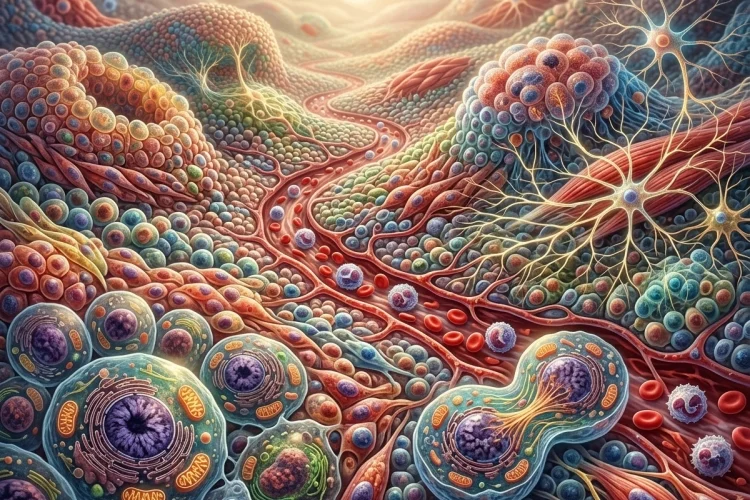
A neuron, for example, can develop long projections that carry signals across significant distances. Muscle cells can be elongated, while certain immune cells can change shape as they move through tissues.
Plant cells can also be highly specialized, but their strong walls provide a structural framework that makes them less physically adaptable than many animal cells.
5. Energy Storage Works Differently
Both plants and animals need ways to store excess chemical energy, but they tend to use different storage molecules.
Plants commonly store glucose in the form of starch. This can accumulate in specialized tissues and plastids, providing an energy reserve for future growth, reproduction, or periods when photosynthesis cannot supply enough sugar.
Animals commonly store carbohydrate reserves as glycogen, especially in tissues such as the liver and muscles.
These differences make biological sense when we consider their lifestyles.
Plants produce sugars through photosynthesis and need to manage energy across changing day-night cycles and seasons. Animals must manage energy obtained from meals, which may arrive at irregular intervals.
The underlying chemistry is different, but the goal is similar: save useful energy now so it can be accessed later.
6. Cell Division Is Not Exactly the Same
Both animal and plant cells can divide through mitosis, a process that distributes duplicated chromosomes into daughter cells.
The biggest difference appears during cytokinesis, when the physical cell divides.
Because animal cells have flexible membranes, a cleavage furrow can form and gradually pinch the cell into two daughter cells.
A plant cell cannot simply squeeze inward because its rigid wall would get in the way. Instead, plant cells construct a cell plate between the daughter cells. This eventually contributes to the new cell walls that seperate them.
This is a great example of how one structural difference-the cell wall-can influence an entirely different cellular process.
7. Animal and Plant Cells Have Plenty in Common
Focusing only on differences can create the false impression that these cells are completely unrelated.
They actually share much of their basic cellular machinery.
Both have a nucleus, DNA, plasma membrane, cytoplasm, mitochondria, ribosomes, endoplasmic reticulum, Golgi apparatus, cytoskeleton, and peroxisomes.
Ribosomes make proteins. The nucleus stores most genetic information. Mitochondria help provide usable cellular energy, while the endoplasmic reticulum and Golgi apparatus contribute to protein and lipid processing.
These common features exist because plants and animals are both eukaryotes and share ancient evolutionary ancestry.
So rather than thinking of plant and animal cells as completely different designs, it is more accurate to see them as variations on the same fundamental eukaryotic system.
Why Do These Differences Matter?
Understanding animal and plant cell structure goes far beyond passing a biology exam.
Plant cell biology is essential to agriculture, crop improvement, forestry, climate science, and biotechnology. Researchers studying drought resistance, for instance, must understand how plant cells manage water, cell walls, vacuoles, and photosynthesis.
Animal cell research is equally important in medicine. Scientists studying cancer, genetic diseases, immune responses, tissue regeneration, and drug development often focus on how animal cells grow, communicate, divide, and respond to their enviroment.
The differences also explain everyday observations.
Why does lettuce wilt when it loses water? Vacuoles and turgor pressure play a role. Why do green leaves capture sunlight but human skin does not? Chloroplasts are part of the answer.
Cell biology connects microscopic structures to things we can observe every day.
The animal cells vs. plant cells comparison becomes much easier once you connect structure with function.
Both are eukaryotic cells with nuclei, mitochondria, ribosomes, DNA, and many of the same internal organelles, but their lifestyles have produced several important differences.
Plant cells have cell walls, chloroplasts, and typically a large central vacuole, helping plants maintain structure, manage water, and perform photosynthesis.
Animal cells lack cell walls and chloroplasts, giving them greater flexibility and allowing cells to develop a wide variety of specialized forms.
Instead of simply memorizing organelles, try asking why each structure exists and what problem it solves.
That approach makes cell biology easier to remember-and much more interesting. Continue exploring cellular structure to see how these microscopic systems shape every form of complex life.