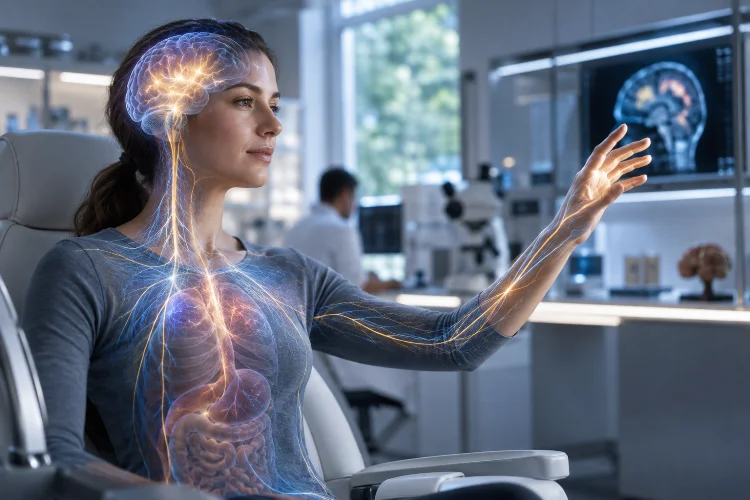
You raise your hand, take a breath, remember someone’s name, feel hungry, and react when you touch something hot-all without stopping to think about the incredible system making those actions possible.
At the center of it all is the brain.
Understanding how the human brain controls the body means looking at how billions of nerve cells communicate with muscles, organs, glands, and sensory systems.
Some of this control is voluntary, such as deciding to walk across a room. Other processes happen automatically, including breathing, heart-rate regulation, digestion, and maintaining body temperature.
The brain does not work alone. It forms part of the central nervous system alongside the spinal cord and constantly exchanges information with the peripheral nerves running throughout the body.
Rather than acting like a single control switch, the brain is more like an incredibly complex network. Different regions specialize in different jobs, yet they continuously cooperate to keep us moving, thinking, sensing, and alive.
The Brain Is the Body’s Main Control Center
The human brain is part of the central nervous system, or CNS, together with the spinal cord. The peripheral nervous system connects this central network to muscles, skin, sensory organs, and internal organs throughout the body.
The adult human brain contains roughly 86 billion neurons, although the exact number varies between individuals. These nerve cells communicate through electrical and chemical signals, creating enormous networks capable of processing information.
Every second, the brain receives signals about what is happening both inside and outside the body.
Your eyes send visual information. Your ears provide sound and balance signals. Receptors in your skin detect pressure, temperature, and pain, while internal sensors provide information about things such as blood pressure and oxygen levels.
The brain processes these signals and produces appropriate responses.
If you see a ball flying toward your face, for example, your visual system detects it, your brain estimates its direction, and motor areas help coordinate movements that allow you to duck or raise your hands.
This can happen in a fraction of a second.
Neurons Carry Messages Around the Body
The brain communicates through specialized cells known as neurons.
Neurons can transmit electrical signals along extensions called axons. When a signal reaches the end of a neuron, chemical messengers called neurotransmitters can cross tiny gaps known as synapses and influence nearby cells.
This allows information to travel through huge neural networks.
Some neurons carry sensory information toward the central nervous system, while motor neurons transmit commands toward muscles and glands.
Imagine accidentally touching a hot pan.
Temperature and pain receptors in your skin generate signals that travel through sensory nerves. Those signals reach the spinal cord and brain, where the information is interpreted as dangerous heat.
Motor signals can then activate muscles that move your hand away.
Interestingly, some protective reflexes involve the spinal cord before conscious awareness fully catches up. This allows the body to respond extremely quickly to potential injury.
The nervous system is therefore not simply a one-way communication channel. It is constantly receiving, interpreting, and responding to information.
Different Brain Regions Control Different Functions
The brain contains many specialized regions, and no single area controls everything.
The largest part is the cerebrum, which is divided into left and right hemispheres. Its outer layer, the cerebral cortex, plays major roles in perception, language, memory, decision-making, and voluntary movement.
The cortex itself contains several major lobes.
The frontal lobe is strongly involved in planning, decision-making, personality, and voluntary movement. The parietal lobe processes information related to touch and spatial awareness.
The temporal lobe contributes to hearing, language, and memory, while the occipital lobe is heavily involved in visual processing.
Another major region, the cerebellum, helps coordinate movement, posture, timing, and balance.
Meanwhile, the brainstem connects the brain with the spinal cord and helps regulate essential automatic functions such as breathing, heart rate, and aspects of sleep.
These regions do not operate in isolation. Even simple actions usually require multiple parts of the brain working together.
How the Brain Controls Voluntary Movement
When you decide to stand up, wave, type, or kick a football, your brain must transform an intention into coordinated muscle activity.
One important region involved in this process is the motor cortex, located in the frontal lobe.
Neurons in motor-related areas send signals through pathways that travel down the brainstem and spinal cord. These signals eventually reach motor neurons connected to skeletal muscles.
Muscles respond by contracting or relaxing.
But movement requires much more than simply telling one muscle to contract.
Imagine picking up a glass of water.
Your brain must estimate where the glass is located, position your arm, adjust your hand, control grip strength, maintain balance, and continuously update the movement using visual and sensory feedback.
The cerebellum plays an important role in making these movements smooth and accurate.
Without coordination between sensory information and motor commands, even basic movements would become clumsy and inefficent.
The Brain Also Controls Automatic Body Functions
You do not normally have to remind yourself to breathe every few seconds.
That is because the brain automatically regulates many essential processes.
The brainstem, including areas within the medulla oblongata and pons, contains neural circuits involved in controlling breathing, heart function, blood pressure, swallowing, and other basic activities.
Breathing provides a good example.
The nervous system monitors chemical changes in the blood, including carbon dioxide levels. When carbon dioxide rises, breathing centers can adjust the rate and depth of respiration.
This happens even while you are asleep.
Another system known as the autonomic nervous system helps regulate involuntary processes such as heart rate, digestion, pupil size, and gland activity.
It has two major divisions commonly called the sympathetic and parasympathetic systems.
The sympathetic system helps prepare the body for demanding situations, while the parasympathetic system generally supports rest, digestion, and energy conservation.
Together, they continually adjust internal organs to changing conditions.
How the Brain Processes Sensory Information
Your brain never directly touches light, sound waves, or external objects.
Instead, sensory organs convert physical information into nerve signals.
The eyes translate light into electrical activity. The ears convert vibrations into neural signals, while receptors in the skin respond to pressure, temperature, and tissue damage.
These signals travel to the brain, where they are processed into what we experience as sight, sound, touch, taste, smell, and body position.
The Brain Does More Than Simply Receive Information
Perception is not just passive recording.
The brain interprets incoming signals using context, expectations, attention, and previous experiences.
For example, your visual system receives a constantly changing stream of light, yet the brain organizes it into recognizable objects, faces, depth, movement, and color.
This explains why optical illusions can fool us. The brain is trying to create the most useful interpretation of sensory information, but that interpretation is not always perfectly accurate.
Sensory processing is therefore an active biological process rather than a simple camera-like recording of reality.
The Brain and Hormones Work Together
The brain can control the body through more than nerve impulses.
It also interacts closely with the endocrine system, which uses hormones to influence organs and tissues.
One especially important brain region is the hypothalamus.
The hypothalamus helps regulate hunger, thirst, body temperature, sleep, stress responses, and many other functions. It also communicates with the pituitary gland, sometimes called the body’s “master gland.”
The pituitary releases hormones that influence other endocrine organs, including the thyroid gland, adrenal glands, and reproductive organs.
Through this system, the brain can influence processes that happen over minutes, hours, days, or even years.
Growth, metabolism, reproduction, and responses to stress all involve communication between the nervous and endocrine systems.
So the brain does not simply send fast electrical commands. It also helps manage slower chemical communication throughout the body.
Emotions Can Change What Happens in the Body
Emotions may feel psychological, but they can produce very real physical responses.
If you suddenly become frightened, brain circuits involved in threat detection can activate the autonomic nervous system.
Your heart may beat faster, your breathing can speed up, your pupils may widen, and blood flow may shift toward muscles.
Hormones such as adrenaline may also be released.
These responses can prepare the body to react rapidly to danger.
The reverse can happen during calm conditions. Parasympathetic activity may slow the heart, support digestion, and encourage the body to conserve energy.
This connection explains why emotional states can affect sleep, appetite, muscle tension, digestion, and other bodily functions.
The brain and body are not seperate systems. They continuously influence one another.
Memory and Learning Change Brain Control
The brain is not a fixed machine.
It can modify its connections through a property known as neuroplasticity.
When you learn a new skill-such as playing piano, riding a bicycle, or typing quickly-repeated activity helps strengthen and reorganize neural networks.
At first, a new movement may require intense concentration.
After enough practice, it can become much more automatic.
This is partly because the nervous system becomes better at coordinating the sensory information, muscle commands, timing, and predictions required for the task.
Neuroplasticity also plays an important role after certain brain injuries. In some situations, rehabilitation can help surviving neural networks adapt and partly compensate for damaged areas.
The brain’s ability to change is one of the reasons practice can have such a powerful effect on human behavior and physical skills.
What Happens When Brain Control Is Disrupted?
Because the brain controls so many processes, damage to different regions can produce very different symptoms.
A stroke affecting motor areas may cause weakness or paralysis. Damage involving language regions can make speaking or understanding speech difficult.
Injury to the cerebellum can affect balance and coordination, while problems involving the brainstem may interfere with vital functions such as breathing or consciousness.
Neurological diseases can also disrupt communication between the brain and body.
Parkinson’s disease, for example, affects neural systems involved in movement. Multiple sclerosis damages structures that help nerve signals travel efficiently, while epilepsy involves abnormal patterns of electrical activity in the brain.
These conditions demonstrate just how dependent normal body function is on precise neural communication.
Understanding how the human brain controls the body reveals just how interconnected our nervous system really is.
The brain receives sensory information, interprets what is happening, sends movement commands, regulates internal organs, influences hormones, creates emotions, and continuously adjusts the body to changing conditions.
Different regions specialize in tasks such as movement, vision, memory, balance, and automatic survival functions, but almost none of them work completely alone.
Neurons, the spinal cord, peripheral nerves, hormones, and muscles all cooperate in an extraordianry communication network. Even an everyday action like reaching for a glass requires a remarkable amount of processing.
The next time you walk, breathe, remember something, or react to a sound, consider the billions of neural signals working behind the scenes. Exploring neuroscience is one of the best ways to understand how the body and mind function together.