
Your body is constantly busy, even when you are sitting still. Your heart pumps blood, your lungs exchange gases, your kidneys filter waste, and your nervous system processes information-all at the same time.
These activities are possible because the human body is organized into interconnected organ systems. An organ system is a group of organs that cooperate to perform major biological functions.
The human body is commonly divided into eleven major systems: integumentary, skeletal, muscular, nervous, endocrine, cardiovascular, lymphatic, respiratory, digestive, urinary, and reproductive.
Each system has a primary job, but none works completely alone. Your respiratory system supplies oxygen, for example, while the cardiovascular system carries that oxygen to cells throughout the body.
Understanding the eleven major organ systems of the human body makes anatomy much easier to learn.
Instead of seeing the body as a confusing collection of parts, you can view it as a coordinated biological network built to maintain movement, protection, communication, energy, and survival.
What Is an Organ System?
An organ is a structure made from multiple tissue types that work together. The heart, lungs, kidneys, skin, and stomach are all organs because each contains specialized tissues arranged to perform particular functions.
An organ system forms when several organs cooperate toward a broader purpose. The digestive system, for instance, includes the mouth, esophagus, stomach, intestines, liver, pancreas, and other structures involved in processing food.
The boundaries between systems are not always perfect. The pancreas belongs to the digestive system because it produces digestive enzymes, but it also acts as an endocrine organ by releasing hormones such as insulin.
Assigning an organ to only one system can therefore oversimplify how the body actually works.
Systems That Protect, Support, and Move the Body
1. The Integumentary System
The integumentary system includes the skin, hair, nails, sweat glands, and oil glands. It forms the body’s outer covering and provides the first physical barrier against harmful microorganisms, chemicals, and injuries.
The skin also helps regulate temperature. When you become hot, sweat evaporates from the surface, while changes in blood flow help release or conserve heat.
Sensory receptors in the skin detect pressure, pain, touch, and temperature. The integumentary system is commonly described as the body’s largest organ system because the skin covers its entire external surface.
2. The Skeletal System
The skeletal system includes bones, cartilage, joints, and ligaments. Its framework supports the body, protects internal organs, and provides attachment points for muscles.
The skull protects the brain, the vertebral column surrounds the spinal cord, and the rib cage helps shield the heart and lungs. Bones also store minerals such as calcium and phosphorus.
Bone marrow inside certain bones produces blood cells. This means the skeleton is not simply a dry supporting frame-it is living tissue that grows, repairs itself, stores materials, and contributes to blood formation.
3. The Muscular System
The muscular system produces movement, maintains posture, stabilizes joints, and generates heat. Its most visible components are skeletal muscles, which usually attach to bones through tendons.
When skeletal muscles contract, they pull on bones and create movements such as walking, smiling, or lifting an object. They often work in opposing groups, with one muscle contracting while another relaxes.
The body also contains cardiac muscle in the heart and smooth muscle in blood vessels and internal organs. These muscle types perform involuntary actions such as pumping blood and moving food through the digestive tract.
Systems That Control and Coordinate Activities
4. The Nervous System
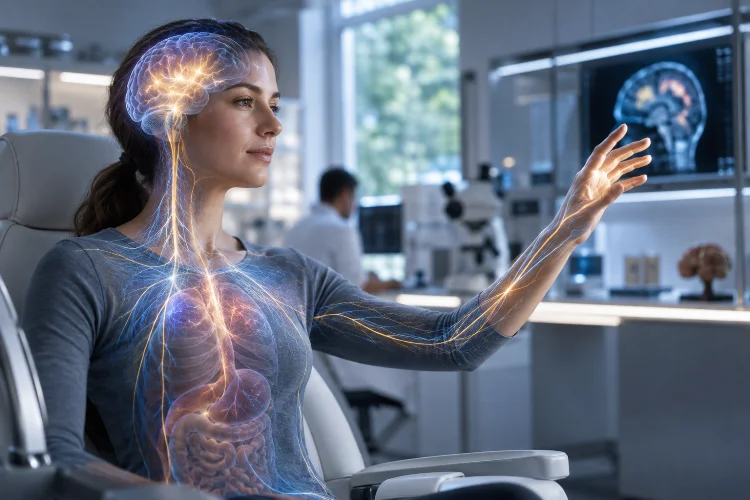
The nervous system includes the brain, spinal cord, nerves, and sensory receptors. It provides fast communication by transmitting electrical and chemical signals.
Your nervous system allows you to see, hear, remember, move voluntarily, and respond to danger. It also controls automatic processes such as breathing, heart rate, digestion, and temperature regulation.
The brain and spinal cord form the central nervous system, while nerves outside them make up the peripheral nervous system. These divisions constantly exchange information so the body can detect changes and produce appropriate responses.
5. The Endocrine System
The endocrine system communicates through hormones rather than rapid nerve signals. Hormones are chemical messengers released into the bloodstream and delivered to specific target tissues.
Major endocrine structures include the pituitary, thyroid, adrenal glands, pancreas, ovaries, and testes. Their hormones help regulate growth, metabolism, stress responses, blood glucose, reproduction, sleep, and fluid balance.
Endocrine messages generally act more slowly than nervous signals, but their effects may last longer. Scientists have identified more than 50 hormones in humans, showing how extensive this chemical communication network is.
Systems That Transport Fluid and Defend the Body
6. The Cardiovascular System
The cardiovascular system consists of the heart, blood, and blood vessels. The heart acts as a muscular pump that keeps blood moving through arteries, capillaries, and veins.
Blood delivers oxygen, nutrients, hormones, heat, and immune cells. It also carries carbon dioxide and other waste products away from tissues.
This transportation network connects almost every organ system. Nutrients absorbed by the digestive tract, oxygen entering through the lungs, and hormones released by endocrine glands all depend on circulation to reach their destinations.
7. The Lymphatic System
The lymphatic system includes lymphatic vessels, lymph nodes, the spleen, thymus, tonsils, and related tissues. It returns excess fluid from body tissues to the bloodstream and plays an important role in immune defense.
Lymph nodes filter lymph and contain immune cells that help detect potential threats. This is why lymph nodes may become swollen when the body is fighting an infection.
The lymphatic system also helps absorb certain dietary fats from the small intestine. It therefore connects fluid balance, immunity, and digestion rather than performing only one isolated job.
Systems That Supply Oxygen and Nutrients
8. The Respiratory System
The respiratory system includes the nose, throat, airways, lungs, and breathing muscles. Its central task is exchanging oxygen and carbon dioxide.
Air travels into the lungs until it reaches tiny air sacs called alveoli. Oxygen crosses into the blood, while carbon dioxide moves from the blood into the lungs to be exhaled.
The respiratory and cardiovascular systems are especially close partners. The lungs exchange gases, but the heart and blood vessels are responsible for carrying those gases between the lungs and body tissues.
9. The Digestive System
The digestive system breaks food into substances small enough for the body to absorb and use. It includes the mouth, esophagus, stomach, intestines, liver, gallbladder, pancreas, rectum, and anus.
Mechanical digestion begins when food is chewed, while enzymes and acids perform chemical digestion. Most nutrient absorption occurs in the small intestine.
Absorbed nutrients enter the blood or lymph and travel to cells, where they may provide energy or materials for growth and repair. Material that cannot be digested eventually leaves the body as solid waste.
Systems That Remove Waste and Support Reproduction
10. The Urinary System
The urinary system consists primarily of two kidneys, two ureters, the bladder, and the urethra. The kidneys filter blood and produce urine containing waste products and extra fluid.
Urine moves through the ureters into the bladder, where it is stored until leaving through the urethra. However, waste removal is only part of the system’s role.
The kidneys also help regulate water, electrolytes, acidity, blood pressure, and red blood cell production. These functions make them essential to maintaining a stable internal environment.
11. The Reproductive System
The reproductive system produces sex cells and supports human reproduction. The main male structures include the testes, epididymis, sperm ducts, prostate, penis, and related glands.
The female system includes the ovaries, uterine tubes, uterus, cervix, vagina, and external structures. The ovaries produce egg cells, while the uterus can support the development of an embryo and fetus.
The reproductive organs also produce hormones involved in sexual development and reproductive function. Unlike most other systems, the reproductive system is not necessary for an individual’s immediate survival, but it is essential for producing future generations.
How the Eleven Organ Systems Work Together
The eleven systems are usually taught separately, but everyday activities reveal how closely they cooperate. Imagine climbing a staircase quickly.
The nervous system coordinates movement, while the muscular and skeletal systems move your body. The respiratory system brings in more oxygen, and the cardiovascular system delivers it to active muscles.
Hormones help adjust energy use, the skin releases heat through sweating, and the urinary system contributes to long-term fluid balance. Nutrients previously processed by the digestive system provide fuel for the activity.
This cooperation supports homeostasis, the body’s ability to keep its internal conditions within workable ranges. When one system develops a serious problem, others often compensate temporarily, but prolonged disruption can affect the entire organism.
The eleven major organ systems of the human body are the integumentary, skeletal, muscular, nervous, endocrine, cardiovascular, lymphatic, respiratory, digestive, urinary, and reproductive systems.
Each contains specialized organs, but all eleven contribute to one coordinated living network. Some systems provide structure and movement, while others handle communication, transportation, defense, nutrition, waste removal, or reproduction.
Their constant interaction allows the body to adapt to exercise, meals, temperature changes, infections, and countless other challenges. Choose one system and trace how it cooperates with at least two others during an everyday activity.
This simple exercise will help you understand human anatomy as an interconnected story instead of a list of organs to memorize.