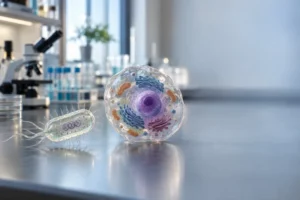
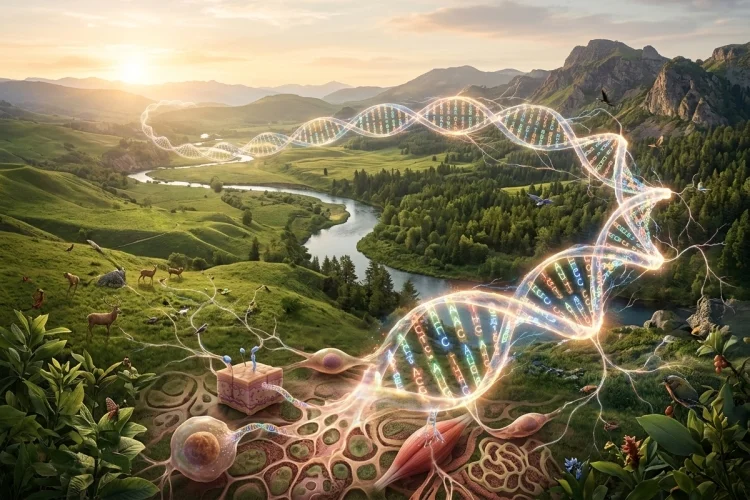
Every cell needs instructions. A skin cell must know how to protect the body, a muscle cell must produce force, and an immune cell must recognize possible threats. Those instructions are stored in a molecule called DNA.
So, what is DNA and how does it store information? DNA, or deoxyribonucleic acid, is the molecule that carries genetic information in living organisms. Its message is written as a sequence of four chemical bases, almost like a biological text created with a four-letter alphabet.
Cells read selected parts of this text to produce proteins and useful RNA molecules. They also copy DNA before division so the information can pass to new cells and, through reproduction, to future generations.
DNA does not determine every detail of an organism by itself. Environment, development, lifestyle, and chance also influence biological outcomes. Still, understanding DNA is essential for learning about heredity, evolution, health, and the machinery that keeps life running.
What Is DNA?
DNA is a nucleic acid containing instructions for an organism’s development and normal functioning. In most human cells, the majority of it is stored inside the nucleus, with a smaller amount found in mitochondria.
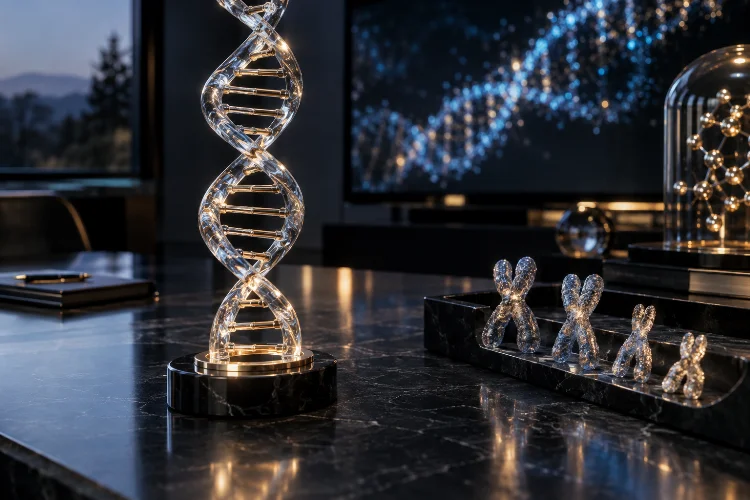
The molecule has a double-helix shape, often compared to a twisted ladder. Repeating sugar and phosphate groups form its sides, while pairs of chemical bases create the rungs.
DNA molecules can be extremely long. Eukaryotic cells therefore wrap them around proteins and organize them into chromosomes, allowing the genetic material to fit inside a microscopic nucleus.
The Four-Letter Alphabet of DNA
DNA stores information using four nucleotide bases: adenine, thymine, cytosine, and guanine. They are represented by A, T, C, and G.
The order of these letters creates the message. A sequence such as A-C-G-T carries different information from A-G-C-T, just as rearranging letters can change a word.
The bases follow pairing rules: A pairs with T, while C pairs with G. This complementary relationship holds the strands together and helps cells copy the sequence.
Not every DNA region is a protein recipe. Some sequences regulate gene activity, organize chromosomes, or produce functional RNA, while other non-coding regions have no currently known function.
How Cells Turn DNA Into Proteins
A gene is a DNA region containing information for a functional product. Many genes guide protein production, although some produce RNA molecules that work without becoming proteins.
Protein production begins with transcription. The cell makes an RNA copy of a selected sequence, and messenger RNA carries the information to a ribosome.
The ribosome reads the message in three-base units called codons. Most codons specify an amino acid, while others act as start or stop signals. Amino acids are then joined and folded into a protein.
Proteins serve as enzymes, antibodies, receptors, structural materials, and chemical messengers. This is how the order of DNA bases can influence what a cell builds and how it behaves.
DNA Works Like a Carefully Organized Library
DNA is often called a blueprint, but a library may be a better comparison. Nearly every cell in your body contains essentially the same genetic collection, yet different cell types read different sections.
A nerve cell activates genes involved in communication, while a muscle cell relies heavily on genes related to contraction. This controlled use of information is called gene expression.
The complete collection of an organism’s DNA is its genome. One set of the human genome contains roughly three billion nucleotides and about 20,000 protein-coding genes.
Most human body cells contain 23 chromosome pairs. DNA is wrapped around proteins to form chromatin, which helps package it and control which regions are accessible.
How DNA Copies and Protects Its Message
Before most cells divide, they copy their DNA through a process called DNA replication. The two strands separate, and each original strand becomes a template for a new complementary strand.
Because A pairs with T and C pairs with G, the cell can reproduce the sequence with high accuracy. The result is two DNA molecules, each containing one original strand and one newly built strand.
Cells also use proofreading and repair systems to correct many errors and forms of damage. These systems are effective but not perfect.
A lasting change in the sequence is called a mutation. Mutations may result from copying errors or damage caused by ultraviolet radiation, chemicals, and other factors.
How DNA Creates Inheritance and Variation
DNA passes information from cells to their descendants and from parents to offspring. This biological continuity explains why relatives often share physical and biological traits.
However, offspring are not exact copies of their parents. Sexual reproduction mixes genetic material, creating new combinations of DNA variants.
The effects of mutations and genetic variations differ widely. Some have no noticeable impact, while others alter proteins, change gene regulation, increase disease risk, or occasionally provide an advantage in a particular environment.
Heritable variation is also essential for evolution. When DNA differences affect survival or reproduction, their frequency may change within a population over many generations.
This balance between stability and variation is one of DNA’s most important qualities. It preserves essential information while allowing populations to adapt and change.
Why Understanding DNA Matters
DNA science supports medicine, agriculture, forensics, conservation, and biotechnology. Researchers analyze genetic sequences to investigate inherited disorders, identify microorganisms, study tumors, and measure diversity in endangered populations.
Doctors may use genetic information to clarify a diagnosis or select a treatment. Agricultural researchers can study useful traits such as disease resistance, nutritional content, or tolerance to drought.
DNA analysis also supports forensic investigations and biological identification. However, a DNA match or genetic result must be evaluated alongside other evidence rather than treated as automatically conclusive.
Genetic findings require careful interpretation. A variant may increase the probability of a condition without guaranteeing it because health often depends on several genes, environmental influences, and behavior.
DNA data also raises questions about privacy, consent, access, and discrimination. Knowing the basic science helps people understand both the possibilities and limitations of genetic testing.
DNA is the information-carrying molecule of life. It stores biological instructions in the order of four bases-A, T, C, and G-arranged along two complementary strands.
Cells copy this sequence during replication and read selected genes through RNA to make proteins or other useful molecules.
The information is packaged into chromosomes and carefully regulated so different cells can perform specialized jobs. Mutations create genetic variation, while inheritance passes DNA between generations.
Continue your biology journey by exploring transcription and translation. Once you understand how a DNA sequence becomes a working protein, genetics becomes much easier to visualize and connect to health, heredity, evolution, and everyday life.