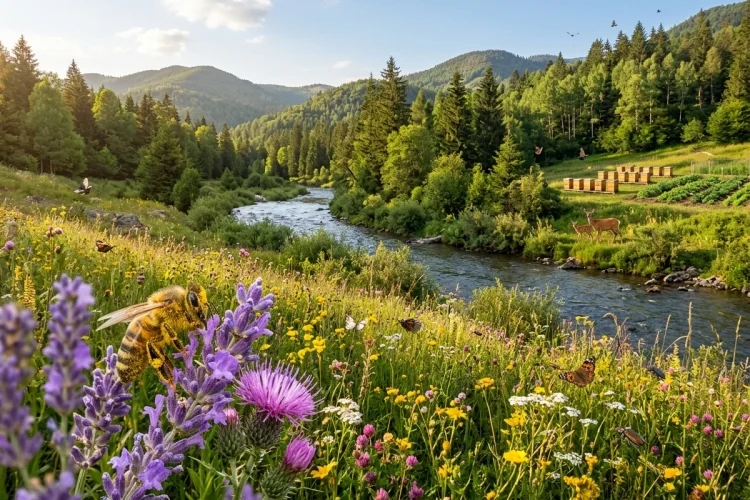
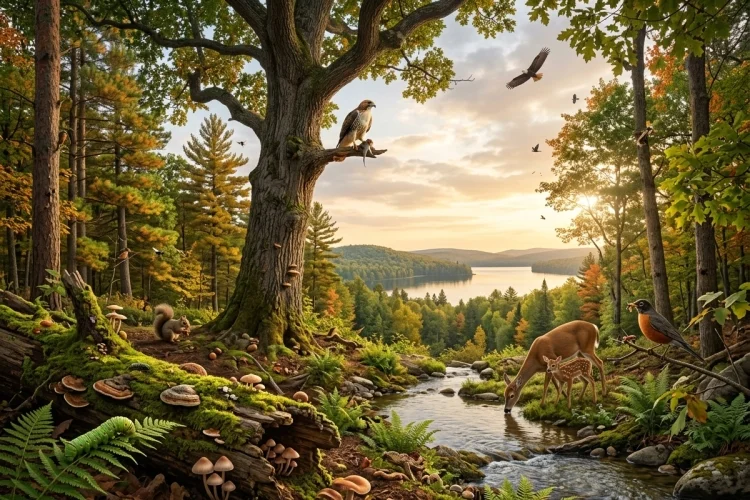
A forest may look peaceful, but it is never truly still. Plants capture sunlight, insects eat leaves, birds hunt insects, fungi break down fallen wood, and nutrients move back into the soil. Thousands of interactions are happening at the same time.
Together, these living organisms and their physical surroundings form an ecosystem. Ecosystems can be as large as an ocean or as small as a pond, garden, or decaying log. What matters is that living and nonliving components interact as one connected system.
Understanding how ecosystems work helps us make sense of food webs, population changes, nutrient cycles, biodiversity, and environmental balance. It also reveals why the loss of one species or a change in rainfall can affect many other parts of nature.
Ecosystems are not perfectly stable machines. They are dynamic networks that constantly respond to seasons, disturbances, migration, competition, and human activity. Let’s explore the processes that keep these natural systems running.
What Is an Ecosystem?
An ecosystem includes a community of living organisms and the nonliving environment with which they interact. A forest ecosystem, for example, includes trees, animals, fungi, and microorganisms along with soil, water, sunlight, air, and climate.
The living components are called biotic factors. They include plants, animals, fungi, bacteria, and every other organism in the area.
The nonliving components are known as abiotic factors. Temperature, rainfall, sunlight, oxygen, minerals, soil type, and water chemistry are common examples.
These two sides cannot be separated completely. Soil nutrients influence plant growth, plants provide food and shelter for animals, and decomposers return materials from dead organisms to the soil. An ecosystem works through these continuous connections.
Ecosystems also exist at different scales. A coral reef is an ecosystem, but so is the wider ocean region around it. Scientists choose boundaries based on the question they want to investigate.
Biotic and Abiotic Factors Shape the System
Every species has a range of environmental conditions in which it can survive. A cactus is suited to dry conditions, while many amphibians depend on moist habitats because their skin loses water easily.
Abiotic factors can limit where organisms live and how quickly populations grow. Temperature may control breeding seasons, rainfall can affect plant productivity, and soil acidity may determine which species can obtain nutrients.
Living organisms can also change their physical surroundings. Tree roots stabilize soil, earthworms alter its structure, and wetland plants can slow moving water.
This creates a two-way relationship. The environment shapes organisms, but organisms also modify the environment.
Small changes can sometimes have wider effects. A prolonged drought may reduce plant growth, leaving less food for herbivores. Predator populations may then decline because fewer prey animals are available.
Energy Enters Through Producers
Most ecosystems depend on energy from the sun. Plants, algae, and some bacteria capture light energy through photosynthesis and store part of it in energy-rich organic molecules.
These organisms are called primary producers because they create the biological material that supports the rest of the food web. In deep-sea environments without sunlight, certain microorganisms use chemical energy instead.
Consumers obtain energy by eating other organisms. Herbivores eat producers, carnivores eat animals, and omnivores consume both plant and animal material.
Decomposers and detritivores feed on dead organisms, waste, and other organic remains. Fungi, bacteria, earthworms, and many insects perform this essential cleanup work.
Energy moves in one main direction through an ecosystem. It enters as sunlight or chemical energy, passes through living organisms, and eventually leaves as heat.
Because energy is lost at every transfer, less is available at higher feeding levels. This is why an ecosystem can usually support many producers, fewer herbivores, and an even smaller number of top predators.
Food Chains Connect to Form Food Webs
A food chain presents one simple route through which energy moves. Grass might be eaten by a grasshopper, which is eaten by a frog, which is then eaten by a snake.
Nature is rarely that simple. A frog may eat several insect species, while the snake may also hunt mice, birds, or lizards. Multiple food chains therefore connect to form a food web.
Food webs describe who eats whom and help show how energy passes through an ecological community. Producers form the base, followed by different levels of consumers and predators.
These connections mean that a population change can spread beyond one species. If a major prey population declines, several predators may lose an important food source.
Removing a predator can also allow its prey to increase rapidly. The growing prey population may then consume more plants or compete more strongly with other species.
Food webs are especially complex in oceans because many animals change diets as they grow or move between habitats during different seasons. A species can occupy more than one feeding role during its lifetime.
Matter Is Recycled Through Nutrient Cycles
Energy moves through ecosystems, but matter is reused. Water, carbon, nitrogen, phosphorus, and other materials cycle between living organisms and the physical environment.
Plants absorb water and mineral nutrients from soil. Animals obtain those materials by eating plants or other animals.
When organisms produce waste or die, decomposers break down their remains. This releases nutrients that can be used again by producers.
These movements are known as biogeochemical cycles because they involve biological, geological, and chemical processes. Unlike energy, which eventually leaves as heat, matter is continuously recycled through living and nonliving parts of the biosphere.
The nitrogen cycle provides a useful example. Plants need nitrogen to build proteins and genetic material, but most cannot directly use nitrogen gas from the atmosphere.
Certain microorganisms convert nitrogen into forms that plants can absorb. Other organisms return it to the soil or atmosphere through decomposition and additional microbial processes.
Nutrient balance is important. Excess nitrogen and phosphorus entering lakes and rivers can encourage heavy algal growth. When the algae die and decompose, oxygen levels may fall, creating difficult conditions for fish and other aquatic organisms.
Species Interactions Influence Ecosystem Balance
Organisms affect one another through competition, predation, mutualism, parasitism, and other ecological relationships.
Competition occurs when organisms need the same limited resource, such as food, sunlight, water, or nesting space. It may happen between members of one species or among different species.
Predation transfers energy while influencing the sizes and behaviors of prey populations. Predators may prevent certain species from becoming so abundant that they exhaust their resources.
Mutualism benefits both participants. Bees receive nectar from flowers while helping the plants reproduce through pollination.
Parasitism benefits one organism while harming another. Ticks, tapeworms, and many disease-causing microbes depend on hosts for resources.
No species exists completely alone. Even organisms that never meet directly can influence each other through shared food, predators, habitats, or environmental effects.
Ecosystems Change Through Disturbance and Succession
Ecosystems naturally change over time. Fires, floods, storms, droughts, volcanic activity, and disease outbreaks can disturb established communities.
A disturbance is not always entirely harmful. Some grasslands and forests depend on occasional fires to remove old vegetation, release nutrients, or create conditions needed for certain seeds to germinate.
After a disturbance, communities may recover through ecological succession. Grasses and small plants may colonize an open area first, followed by shrubs and larger trees.
Recovery does not necessarily recreate the exact ecosystem that existed before. The outcome depends on the remaining soil, surviving organisms, climate, invasive species, and the frequency of further disturbances.
An ecosystem’s ability to resist change or recover afterward is often described as resilience. Greater biological diversity can sometimes provide more ways for essential functions to continue, although resilience depends on the particular ecosystem and disturbance.
Human activities can create disturbances that are unusually intense or frequent. Habitat destruction, pollution, overharvesting, invasive species, and changing climate conditions may push ecosystems beyond their capacity to recover.
Why Healthy Ecosystems Matter to People
People depend on ecosystems for food, clean water, raw materials, medicines, and many other resources. Natural systems also regulate processes that are easy to overlook until they stop working properly.
Wetlands can store water and reduce flooding. Vegetation helps prevent erosion, while forests and soils store carbon. Insects, birds, and other animals pollinate both wild plants and agricultural crops.
These benefits are known as ecosystem services. They support human health, communities, economies, and quality of life.
Protecting an ecosystem does not mean preventing all change. Effective conservation usually involves maintaining ecological processes, reducing damaging pressures, and allowing natural recovery where possible.
Individuals can also learn from nearby ecosystems. A park, beach, pond, or garden offers opportunities to observe producers, consumers, decomposers, food-web connections, and environmental conditions.
Ecosystems work through connections between organisms and their physical surroundings. Producers capture energy, consumers transfer it through food webs, and decomposers return nutrients to the environment.
Meanwhile, water and essential elements cycle repeatedly through living and nonliving components. These systems are dynamic rather than perfectly balanced.
Populations rise and fall, habitats change, and communities respond to disturbances. Because every species is connected to others, one change can create effects throughout the wider network.
Choose a nearby habitat and observe it closely. Identify its producers, consumers, decomposers, and abiotic factors, then consider how a change in one part could affect the rest. This simple activity is a great way to see ecosystem science in everyday life.