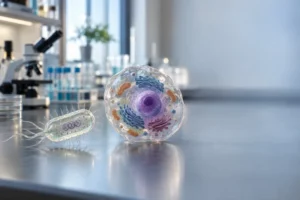
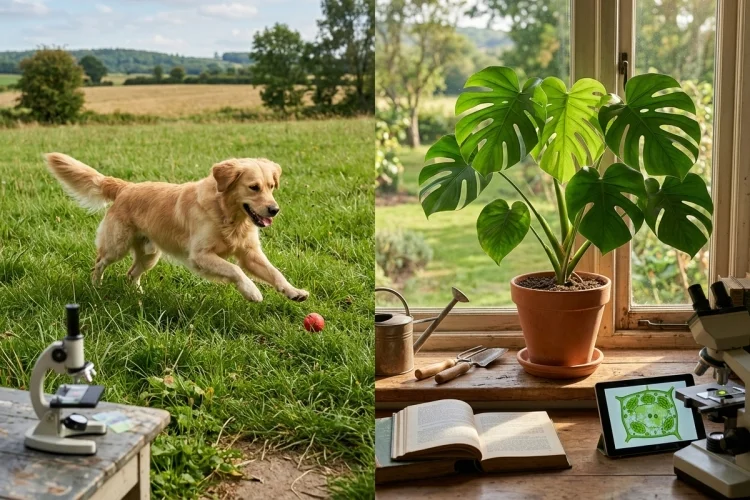
Place a houseplant beside a pet, and the differences seem obvious. The animal can move around, search for food, and react quickly to sounds. The plant stays rooted in one spot, quietly growing toward the light.
However, the biological differences go far beyond movement. Plants and animals are both living, multicellular eukaryotes. Their cells contain DNA, nuclei, mitochondria, membranes, and many of the same basic structures.
Both groups grow, reproduce, use energy, respond to their surroundings, and have evolved countless adaptations.
So, what makes plants different from animals? The main distinctions involve cell structure, nutrition, movement, communication, growth, and reproduction. Most plants use sunlight to produce sugars and are supported by rigid cell walls.
Animals must consume organic material and usually depend on muscles and nervous tissues for rapid movement.
These are broad patterns rather than rules without exceptions. Still, they provide a useful starting point for comparing two of life’s most familiar kingdoms.
Plants and Animals Share a Cellular Foundation
Plants and animals are made of eukaryotic cells, meaning their DNA is enclosed within a nucleus. Both cell types also contain mitochondria, ribosomes, cytoplasm, a plasma membrane, the endoplasmic reticulum, and the Golgi apparatus.
These shared structures help cells release energy, manufacture proteins, transport materials, and maintain stable internal conditions. Plants and animals are therefore not built from completely different biological materials. They use much of the same cellular machinery in different ways.
Plant and Animal Cells Have Different Structures
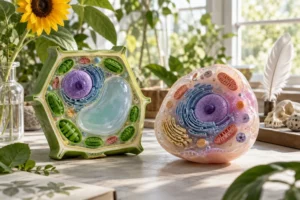
Plant cells usually have a rigid cell wall outside the plasma membrane. Made mainly from cellulose, this wall provides protection, maintains shape, and helps support the plant. Animal cells lack cell walls, so their shapes can be more flexible.
Plant cells also contain chloroplasts, where photosynthesis takes place, and a large central vacuole. The vacuole stores water and other substances while maintaining pressure that keeps many plant tissues firm.
Animal cells do not contain chloroplasts or a large central vacuole. They commonly have centrosomes with centrioles and prominent lysosomes, while their flexible cells can form tissues such as skin, muscle, and nerves.
Plants Make Sugars While Animals Must Eat
Most plants are autotrophs. Through photosynthesis, they capture sunlight and use carbon dioxide and water to produce energy-rich sugars. They also absorb water and minerals from their surroundings and perform cellular respiration to release usable energy from those sugars.
Animals are heterotrophs, meaning they obtain organic material by consuming other organisms or their products. Herbivores eat plants, carnivores eat animals, and omnivores consume both.
Most animal food can ultimately be traced back to photosynthetic organisms. Even a predator indirectly depends on plants or algae because its prey received energy from producers lower in the food web.
There are exceptions. Some parasitic plants obtain carbon from host plants, while carnivorous plants capture animals mainly for nutrients such as nitrogen rather than as a replacement for photosynthesis.
Animals Move Quickly, but Plants Still Respond
Most animals can move from place to place during at least one stage of life. Muscle tissue produces movement, while nervous tissue detects information and coordinates rapid responses.
Mobility helps animals find food, escape predators, locate mates, and reach better habitats. Plants are generally rooted, but they are not passive.
Plants detect light, gravity, touch, temperature, water, and chemicals. Shoots may grow toward light, roots respond to gravity, vines wrap around supports, and Mimosa pudica folds its leaves when touched.
These responses usually depend on hormones, cell growth, or changes in water pressure rather than muscles and nerves. They may look slower than animal behavior, but they allow plants to adjust continuously to local conditions.
Their Growth and Body Plans Follow Different Patterns
Many plants show indeterminate growth, meaning active regions called meristems can continue producing new cells. Apical meristems extend roots and shoots, while lateral meristems can increase stem and root thickness.
This flexible development allows a plant to add branches, leaves, roots, and flowers throughout its life. A tree can therefore keep changing its form for decades.
Most animals develop a more determined body plan. Their basic arrangement of limbs, organs, and body regions is established during development, even though the body may continue increasing in size.
Animals also possess muscle and nervous tissues that plants lack. Complex animals organize these tissues with epithelial and connective tissues to form organs and organ systems.
Plants and Animals Reproduce Differently
Both kingdoms use sexual reproduction, but their life cycles and structures differ.
In flowering plants, pollen carries male reproductive cells, while ovules contain female reproductive cells. Pollination may involve wind, water, insects, birds, or other animals. After fertilization, an ovule can develop into a seed, often enclosed in a fruit.
Plants can also reproduce asexually from stems, roots, leaves, bulbs, runners, or other vegetative parts. Potatoes growing from tubers and strawberries spreading through runners are familiar examples.
Most animals reproduce sexually by combining egg and sperm cells. Fertilization may occur inside or outside the body. Asexual methods such as budding, fragmentation, and parthenogenesis also occur, but they are less common among familiar animal groups.
Plants and Animals Fill Different Ecological Roles
Plants commonly serve as primary producers. By making organic material through photosynthesis, they form the energy foundation of most land-based food webs.
They also provide habitats, stabilize soil, influence water cycles, and store carbon. Animals usually act as consumers, but they also pollinate flowers, disperse seeds, control populations, recycle nutrients, and build habitats.
The relationship is deeply interdependent. Many plants rely on animals for reproduction, while animals depend on plants directly or indirectly for food, oxygen, and shelter.
These differences do not mean that one group is more advanced. Evolution has simply shaped plants and animals around contrasting ways of obtaining resources, responding to challenges, and surviving.
Plants and animals share the basic features of eukaryotic life, but they solve biological challenges in different ways.
Plant cells usually contain cellulose walls, chloroplasts, and large central vacuoles, while animal cells are more flexible and support specialized muscle and nervous tissues.
Most plants produce sugars through photosynthesis and respond to their surroundings through growth and chemical signaling.
Animals obtain food from other organisms and commonly use rapid movement to explore their environments. Their growth patterns and reproductive strategies also differ.
The next time you see a tree, flower, bird, or insect, compare how each obtains energy, reacts, grows, and reproduces. Observing these everyday differences is an easy way to make biology more memorable.