
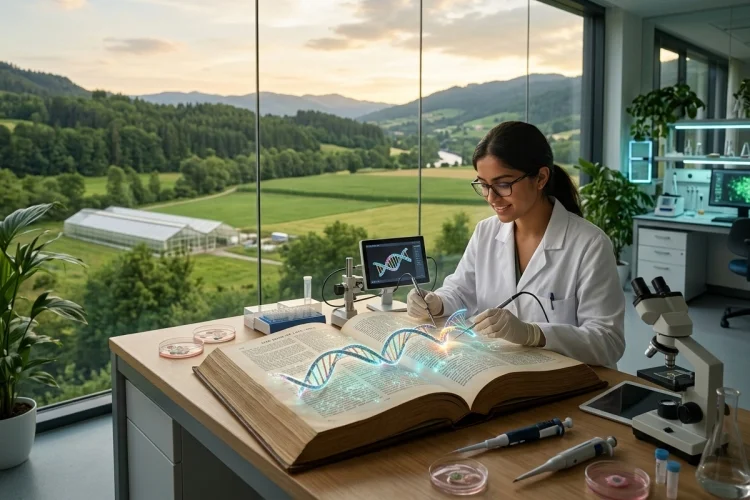
Imagine being able to change one sentence in a massive instruction manual without rewriting the entire book. That is roughly what scientists try to do when they modify DNA through genetic engineering.
DNA contains instructions that influence how cells grow, produce proteins, respond to signals, and perform other biological tasks. By changing a selected DNA sequence, researchers may be able to alter a trait, study a gene, manufacture a useful substance, or develop a potential treatment.
So, how does genetic engineering work? The process usually involves identifying a target gene, designing the desired change, delivering genetic material or editing tools into cells, and testing whether the modification works as intended.
The exact method depends on the goal. Scientists may insert a gene into bacteria to produce a protein, remove an unwanted sequence from a crop, or edit cells for medical research.
This beginner-friendly guide explains the main steps, common tools, practical applications, and important limitations of modern genetic technology.
What Is Genetic Engineering?
Genetic engineering is the use of laboratory-based methods to alter the DNA of an organism. Scientists may add a DNA segment, remove an existing section, replace a sequence, or change individual DNA letters.
These modifications can affect how a gene functions or how strongly it is expressed. A change may help a cell produce a new protein, stop producing an unwanted molecule, or display a different biological characteristic.
Genetic engineering is a broad term. It includes older recombinant DNA methods as well as newer genome-editing technologies such as CRISPR. The resulting organism, cell, or microorganism may be described as genetically engineered or genetically modified.
The process does not always involve transferring genes between species. Modern tools can also make small, targeted changes within an organism’s own DNA.
Genetic Engineering vs. Traditional Breeding
Humans have influenced the genetics of plants and animals for thousands of years through selective breeding. Farmers repeatedly chose organisms with useful characteristics, such as larger fruit, better flavor, or calmer behavior, and bred them together.
Traditional breeding mixes large sets of genes from two parents. Scientists then examine the offspring to find individuals with the desired combination of traits.
Genetic engineering works more directly. Researchers can focus on a particular gene or DNA sequence instead of mixing entire genomes and waiting for the right combination to appear.
However, the method is not automatically simple or predictable. A single gene may interact with many other genes, and traits such as growth, drought tolerance, or disease risk often involve complex biological networks.
Genome editing can make some changes more targeted and faster than conventional breeding, but engineered organisms still require careful testing to confirm their traits and identify unintended effects.
How Genetic Engineering Works Step by Step
The details vary between projects, but most genetic engineering follows a similar scientific pathway.
1. Identifying the Target
Researchers begin by deciding what biological feature they want to study or change. They may investigate a gene associated with protein production, disease resistance, cell growth, or another measurable function.
Scientists then use genome databases, DNA sequencing, previous studies, and laboratory experiments to locate the relevant sequence. This stage is essential because changing the wrong region may produce no effect or disrupt an unrelated cellular process.
2. Designing the Genetic Change
Once the target is known, researchers plan the modification. They might insert a working gene, disable an existing one, correct a mutation, or adjust a regulatory sequence that controls gene expression.
The desired DNA may be produced in a laboratory or copied from another biological source. Modern techniques can also guide editing proteins to a precise location without inserting a complete foreign gene.
3. Delivering the DNA or Editing Tool
Genetic material cannot simply be placed beside a cell and expected to work. It must cross cellular barriers and reach the correct location.
Scientists use delivery vehicles called vectors. A vector is often a plasmid or a modified virus capable of carrying DNA into a host cell. Other delivery methods include electrical pulses, microscopic particles, lipid-based carriers, or direct injection.
The best method depends on the target. Bacterial cells, plant tissues, animal cells, and human cells have different structures and may require different approaches.
4. Selecting and Testing Modified Cells
Not every cell receives or correctly uses the engineered material. Researchers therefore need a way to identify cells that were successfully modified.
Those cells are grown, screened, and compared with unmodified controls. Scientists may sequence their DNA, measure protein production, observe physical traits, or test how the cells respond under specific conditions.
Verification is a major part of genetic engineering. Creating a DNA change is not enough; researchers must confirm its exact location, stability, biological effect, and potential unintended consequences.
How Recombinant DNA Technology Works
Recombinant DNA technology is one of the classic foundations of genetic engineering. It involves joining DNA segments to create a new genetic combination.
Scientists often begin with restriction enzymes, proteins originally found in bacteria that cut DNA at particular sequences. These enzymes can create DNA fragments with ends that fit together.
Another enzyme, DNA ligase, joins the selected fragment to a carrier molecule. A common carrier is a plasmid, which is a small circular DNA molecule that can replicate independently inside many bacterial cells.
The engineered plasmid is then introduced into a host such as a bacterium or yeast. As the host grows and divides, it copies the inserted DNA along with its own genetic material.
Under suitable conditions, the host may also read the inserted gene and manufacture its protein. Researchers can grow large numbers of these cells and purify the resulting product.
This method has been used to make medically important proteins. Recombinant human insulin was developed using genetically engineered bacteria, and the FDA approved the first biosynthetic human insulin product in 1982.
How CRISPR Gene Editing Works
CRISPR is a genome-editing technology adapted from biological systems found naturally in bacteria. It allows scientists to target selected DNA sequences more precisely than many earlier methods.
The widely used CRISPR-Cas9 system has two main components. A guide RNA is designed to match a target DNA sequence, while the Cas9 protein acts as a molecular cutting tool.
The guide RNA leads Cas9 to the selected location, where Cas9 cuts the DNA. The cell then attempts to repair the break.
Scientists can use this natural repair process in different ways. An imprecise repair may disable a gene, while a supplied DNA template may encourage the cell to make a specific correction or replacement.
CRISPR has made many genome-editing experiments faster and more accessible, but it is not perfectly accurate. Researchers must check for off-target changes, incomplete editing, and different results among edited cells.
CRISPR is also a tool rather than one single product. Its use in bacteria, plants, laboratory animals, and human cells involves different goals, delivery challenges, risks, and regulatory requirements.
How Genetic Engineering Is Used
1. Medicine and Pharmaceutical Production
Engineered bacteria, yeast, and animal cells can manufacture insulin, antibodies, hormones, enzymes, and other biological medicines. These cells act like tiny production facilities operating under carefully controlled conditions.
Genetic engineering also supports gene therapy. Depending on the condition, researchers may try to add a functional gene, turn off a harmful one, or edit a disease-associated mutation.
Some therapies modify cells outside the body before returning them to the patient. Others deliver genetic material directly into particular tissues.
Gene-based treatments require extensive safety testing because unwanted immune responses, delivery problems, or unintended genetic changes can create serious risks.
2. Agriculture and Food Production
Plant scientists use genetic engineering to investigate or develop traits related to pest resistance, disease protection, nutritional quality, shelf life, and tolerance to environmental stress.
One method introduces a selected gene into plant cells. Scientists then regenerate complete plants from successfully modified tissue and test whether the new characteristic remains stable across generations.
Genome editing may also remove an unwanted gene or alter an existing plant sequence. This can produce a targeted change without necessarily transferring DNA from another species.
An engineered trait does not solve every farming problem. Crop performance still depends on soil, water, climate, pest management, biodiversity, and local agricultural practices.
3. Scientific Research and Industry
Researchers frequently disable or modify genes to discover what those genes do. Comparing edited and unedited cells can reveal how a sequence influences development, metabolism, immunity, or disease.
Engineered microorganisms are also used to produce enzymes, chemicals, food ingredients, and experimental biofuels. Their rapid growth makes them useful biological factories.
Genetic engineering can additionally support environmental research. Modified or selected microbes may be studied for their ability to detect contaminants, process waste, or break down particular substances.
Risks and Ethical Questions
Genetic engineering can produce valuable medicines and scientific discoveries, but every application has limitations.
An edit may affect an unintended DNA location or interfere with other genes. A modified organism could also behave differently under real environmental conditions than it did in a controlled laboratory.
Human genetic engineering raises especially sensitive questions. Changes made in ordinary body cells affect the treated individual, while edits to reproductive cells or embryos could potentially pass to future generations.
This creates concerns about safety, consent, fairness, genetic discrimination, unequal access, and the difference between treating disease and selecting preferred traits.
Agricultural applications raise additional questions about environmental effects, resistant pests, gene movement, biodiversity, labeling, and control of seeds.
These issues cannot be answered through biology alone; they also involve law, ethics, economics, and public values.
Responsible use requires careful experiments, transparent reporting, independent review, effective regulation, and long-term monitoring.
Genetic engineering works by identifying a DNA target, designing a modification, delivering DNA or editing tools into cells, and verifying the results.
Traditional recombinant DNA techniques often use restriction enzymes, plasmids, and host cells, while CRISPR can guide an editing protein to a selected genomic location.
These technologies support medicine, agriculture, scientific research, and industrial production. However, changing DNA does not guarantee a predictable result because genes function within complicated cellular and environmental systems.
Continue exploring by comparing recombinant DNA technology with CRISPR genome editing. Understanding how their tools and goals differ is an excellent next step toward evaluating the real possibilities-and limitations-of modern genetic science.